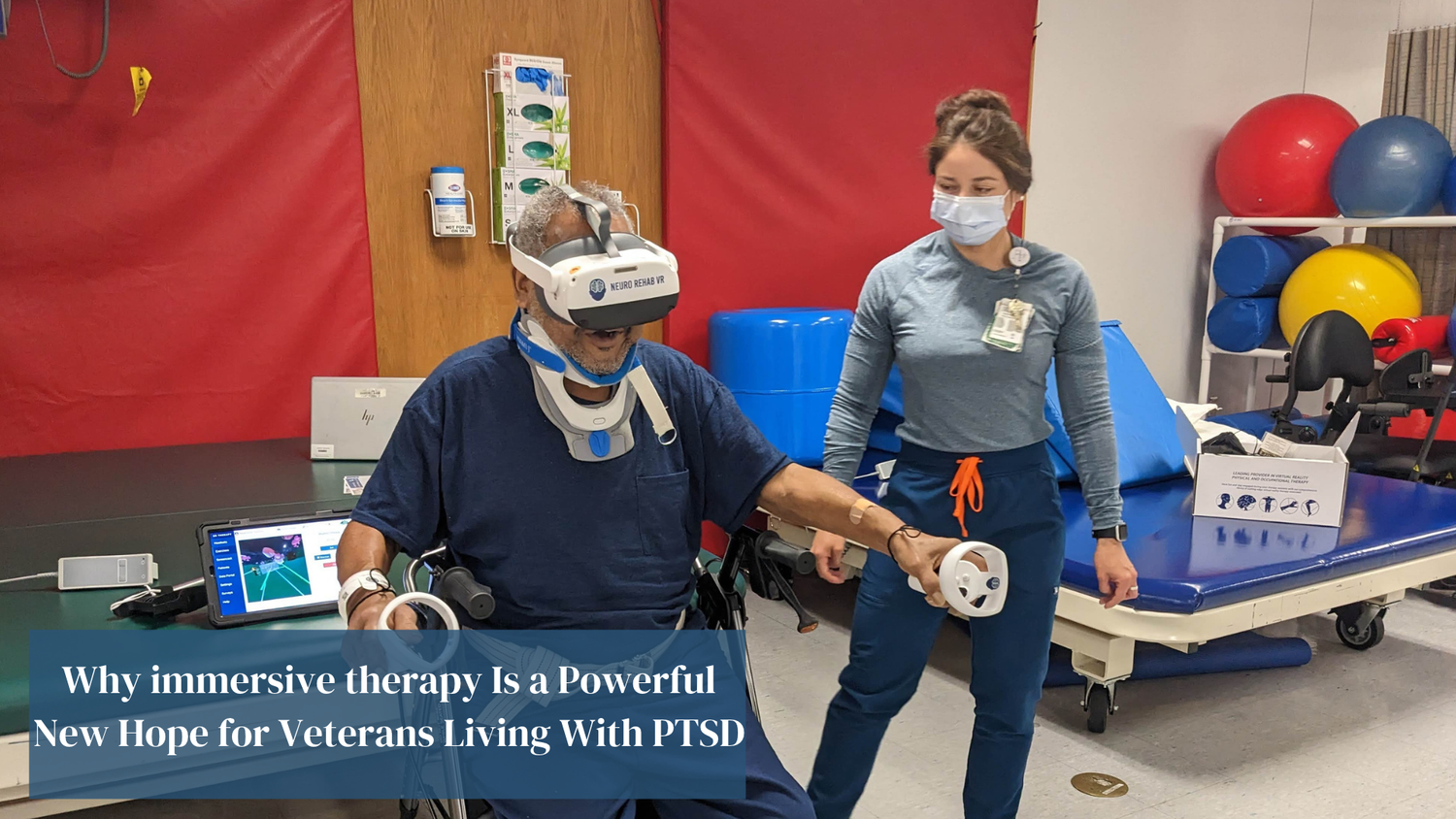
Why immersive therapy Is a Powerful New Hope for Veterans Living With PTSD

American Legion. “VA Using Virtual Reality to Advance Care.” The American Legion, 2025, www.legion.org/information-center/news/veterans-healthcare/2025/december/va-using-virtual-reality-to-advance-care. Accessed 21 Oct. 2026.
Bisson, J. I., et al. “Randomized Controlled Trial of Multi‐Modular Motion‐Assisted Memory Desensitization and Reconsolidation (3MDR) for Male Military Veterans With Treatment‐Resistant Post‐Traumatic Stress Disorder.” Acta Psychiatrica Scandinavica, vol. 142, no. 2, 28 June 2020, pp. 141–151, 10.1111/acps.13200.
Cifu, David X., et al. “Traumatic Brain Injury, Posttraumatic Stress Disorder, and Pain Diagnoses in OIF/OEF/OND Veterans.” Journal of Rehabilitation Research and Development, vol. 50, no. 9, 2013, pp. 1169–1176, 10.1682/jrrd.2013.01.0006.
Deng, Wenrui, et al. “The Efficacy of Virtual Reality Exposure Therapy for PTSD Symptoms: A Systematic Review and Meta-Analysis.” Journal of Affective Disorders, vol. 257, 1 Oct. 2019, pp. 698–709, www.sciencedirect.com/science/article/pii/S0165032719308328, 10.1016/j.jad.2019.07.086. Accessed 20 Oct. 2026.
Edmondson, Donald, et al. “Prevalence of PTSD in Survivors of Stroke and Transient Ischemic Attack: A Meta-Analytic Review.” PLoS ONE, vol. 8, no. 6, 19 June 2013, p. e66435, 10.1371/journal.pone.0066435.
Eshuis, L.V., et al. “Efficacy of Immersive PTSD Treatments: A Systematic Review of Virtual and Augmented Reality Exposure Therapy and a Meta-Analysis of Virtual Reality Exposure Therapy.” Journal of Psychiatric Research, vol. 143, Nov. 2021, pp. 516–527, 10.1016/j.jpsychires.2020.11.030.
Graham, Edward . “VA Expands Use of Extended Reality Tech Across Healthcare Operations – Nextgov/FCW.” Nextgov.Com, 2026, www.nextgov.com/emerging-tech/2026/07/va-expands-use-extended-reality-tech-across-healthcare-operations/414913/. Accessed 20 Oct. 2026.
Heo, Seoyoon, and Jin-Hyuck Park. “Effects of Virtual Reality-Based Graded Exposure Therapy on PTSD Symptoms: A Systematic Review and Meta-Analysis.” International Journal of Environmental Research and Public Health, vol. 19, no. 23, 29 Nov. 2022, p. 15911, 10.3390/ijerph192315911.
Hughes, Katherine C, and Lisa M Shin, 21306214. “Functional Neuroimaging Studies of Post-Traumatic Stress Disorder.” Expert Review of Neurotherapeutics, vol. 11, no. 2, Feb. 2011, pp. 275–85. PubMed Central, pubmed.ncbi.nlm.nih.gov/21306214/, 10.1586/ern.10.198. Accessed 20 Oct. 2026.
Iqbal, Javed, et al. “The Neural Circuits and Molecular Mechanisms Underlying Fear Dysregulation in Posttraumatic Stress Disorder.” Frontiers in Neuroscience, vol. 17, 5 Dec. 2023, 10.3389/fnins.2023.1281401.
Jones, Chelsea, et al. “Virtual Reality–Based Treatment for Military Members and Veterans With Combat-Related Posttraumatic Stress Disorder: Protocol for a Multimodular Motion-Assisted Memory Desensitization and Reconsolidation Randomized Controlled Trial.” JMIR Research Protocols, vol. 9, no. 10, 29 Oct. 2020, p. e20620, 10.2196/20620.
Koenigs, Michael, and Jordan Grafman. “Posttraumatic Stress Disorder: The Role of Medial Prefrontal Cortex and Amygdala.” The Neuroscientist, vol. 15, no. 5, 9 Apr. 2009, pp. 540–548, 10.1177/1073858409333072.
Kothgassner, Oswald D., et al. “Virtual Reality Exposure Therapy for Posttraumatic Stress Disorder (PTSD): A Meta-Analysis.” European Journal of Psychotraumatology, vol. 10, no. 1, 19 Aug. 2019, www.ncbi.nlm.nih.gov/pmc/articles/PMC6713125/, 10.1080/20008198.2019.1654782. Accessed 20 Oct. 2026.
Lazarov, Amit, et al. “Attention to Threat in Posttraumatic Stress Disorder as Indexed by Eye-Tracking Indices: A Systematic Review.” Psychological Medicine, vol. 49, no. 5, 1 Apr. 2019, pp. 705–726, pubmed.ncbi.nlm.nih.gov/30178728/, 10.1017/S0033291718002313. Accessed 20 Oct. 2026.
Lew, Henry L., et al. “Prevalence of Chronic Pain, Posttraumatic Stress Disorder, and Persistent Postconcussive Symptoms in OIF/OEF Veterans: Polytrauma Clinical Triad.” The Journal of Rehabilitation Research and Development, vol. 46, no. 6, 2009, p. 697, 10.1682/jrrd.2009.01.0006.
Milad, Mohammed R., et al. “Neurobiological Basis of Failure to Recall Extinction Memory in Posttraumatic Stress Disorder.” Biological Psychiatry, vol. 66, no. 12, Dec. 2009, pp. 1075–1082, www.biologicalpsychiatryjournal.com/article/S0006-3223(09)00896-8/abstract, 10.1016/j.biopsych.2009.06.026. Accessed 20 Oct. 2026.
National Center for PTSD. “How Common Is PTSD in Adults?” U.S. Department of Veteran Affairs, 26 Mar. 2025, www.ptsd.va.gov/understand/common/common_adults.asp. Accessed 20 Oct. 2026.
Reger, Greg M., et al. “Randomized Controlled Trial of Prolonged Exposure Using Imaginal Exposure Vs. Virtual Reality Exposure in Active Duty Soldiers With Deployment-Related Posttraumatic Stress Disorder (PTSD)..” Journal of Consulting and Clinical Psychology, vol. 84, no. 11, Nov. 2016, pp. 946–959, 10.1037/ccp0000134.
Rizzo, Albert „Skip” . “Bravemind: Virtual Reality Exposure Therapy – Institute for Creative Technologies.” Ict.Usc.Edu, 27 Aug. 2021, ict.usc.edu/research/projects/bravemind-virtual-reality-exposure-therapy/. Accessed 20 Oct. 2026.
Roy, Michael J, et al., 24875691. “Compelling Evidence That Exposure Therapy for PTSD Normalizes Brain Function.” Studies in Health Technology and Informatics, vol. 199, 2014, pp. 61–5. PubMed, pubmed.ncbi.nlm.nih.gov/24875691/. Accessed 20 Oct. 2026.
Roy, Michael J., et al. “Improvement in Cerebral Function With Treatment of Posttraumatic Stress Disordera.” Annals of the New York Academy of Sciences, vol. 1208, no. 1, Oct. 2010, pp. 142–149, 10.1111/j.1749-6632.2010.05689.x.
SAMHSA’s Trauma and Justice Strategic Initiative. SAMHSA’s Concept of Trauma and Guidance for a Trauma-Informed Approach Prepared by SAMHSA’s Trauma and Justice Strategic Initiative. 2014.
Schnurr, Paula P., et al. “The Management of Posttraumatic Stress Disorder and Acute Stress Disorder: Synopsis of the 2023 U.S. Department of Veterans Affairs and U.S. Department of Defense Clinical Practice Guideline.” Annals of Internal Medicine, vol. 177, no. 3, 27 Feb. 2024, www.healthquality.va.gov/guidelines/MH/ptsd/PTSD-in-Annals-2024.pdf, 10.7326/m23-2757. Accessed 20 Oct. 2026.
Smith, Lorin . “Virtual Reality Exposure Therapy to Combat PTSD.” Www.Army.Mil, www.army.mil/article/33128/virtual_reality_exposure_therapy_to_combat_ptsd. Accessed 21 Oct. 2026.
Steenkamp, Maria M., et al. “Psychotherapy for Military-Related PTSD.” JAMA, vol. 314, no. 5, 4 Aug. 2015, p. 489, doi.org/10.1001/jama.2015.8370, 10.1001/jama.2015.8370. Accessed 20 Oct. 2026.
Stein, Murray B, et al. “Risk of Posttraumatic Stress Disorder and Major Depression in Civilian Patients After Mild Traumatic Brain Injury: A TRACK-TBI Study.” JAMA Psychiatry, vol. 76, no. 3, 2019, pp. 249–258, www.ncbi.nlm.nih.gov/pubmed/30698636, 10.1001/jamapsychiatry.2018.4288. Accessed 20 Oct. 2026.
National Center for PTSD. “Traumatic Brain Injury and PTSD.” U.S. Department of Veterans Affairs, www.ptsd.va.gov/understand/related/tbi_ptsd.asp. Accessed 21 Oct. 2026.


