

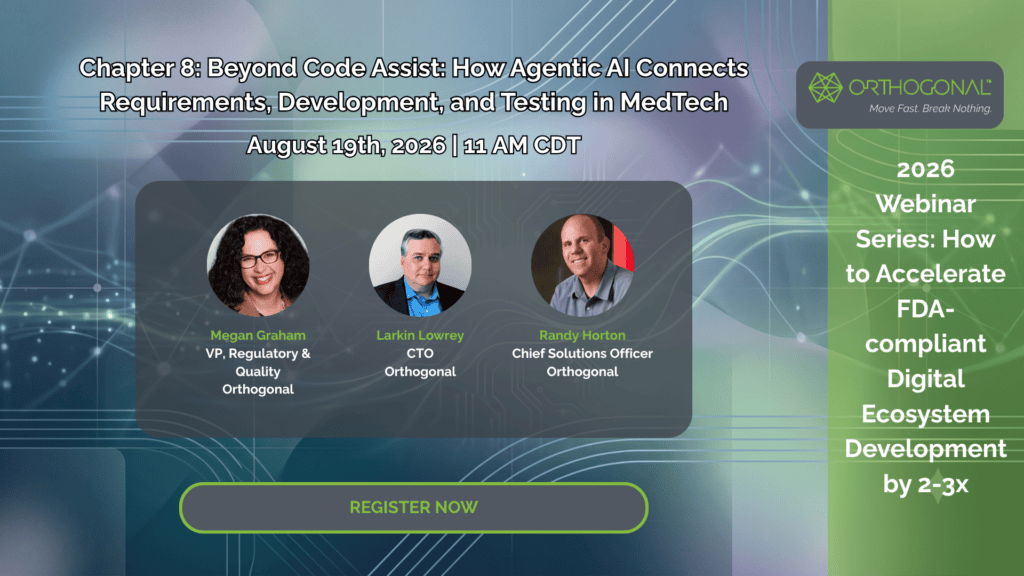
AI can help developers write code faster, but the greater opportunity for MedTech is connecting product intent to clear requirements, working software, and reliable testing to achieve 2-3x gains across the entire product development lifecycle.
Behavior-Driven Development (BDD) provides a practical structure for agentic workflows. Using testable acceptance criteria written in Gherkin, teams can define expected software behavior in a format that product, engineering, quality, and regulatory stakeholders can understand and review.
Join Orthogonal for an illustrative example of how an AI agent can help produce acceptance criteria, build software from them, and test whether the resulting behavior matches the original intent. We will also examine where product knowledge, risk decisions, validation, and human judgment must remain in control.
What You’ll Learn
- Move Beyond AI Code Assist – See how agentic workflows can connect requirements, development, and testing.
- Turn Product Intent into Testable Behavior – Use BDD and Gherkin to create clear, structured acceptance criteria.
- Reduce Requirement Ambiguity – Improve alignment across product, engineering, quality, and regulatory teams.
- Make AI-Generated Work Easier to Review – Review defined behaviors instead of large volumes of generated code.
- Keep Human Judgment in Control – Identify the product, quality, and risk decisions that must remain with experienced people.
- Consider Validation and Risk – Address the oversight and validation needed for agentic AI in regulated development.
Who Should Attend?
- Executive & Business Leaders evaluating how AI can improve product delivery and create business value beyond individual productivity gains.
- Product, Engineering & R&D Leaders responsible for turning product strategy into clear requirements, working software, and reliable tests.
- Quality & Regulatory Leaders assessing how AI-supported development may affect requirement clarity, reviewability, validation, product quality, and risk.
If your organization is considering how agentic AI could fit into its MedTech software development process, this session offers a concrete starting point for connecting human decisions to AI-supported requirements, development, and testing.


